10 File system
The purpose of a file system is to organize and store data. File systems typically support sharing of data among users and applications, as well as persistence so that data is still available after a reboot.
The xv6 file system provides Unix-like files, directories, and pathnames (see Chapter 1), and stores its data on a disk for persistence. The file system addresses several challenges:
The file system needs on-disk data structures to represent the tree of named directories and files, to record the identities of the blocks that hold each file’s content, and to record which areas of the disk are free.
Different processes may operate on the file system at the same time, so the file-system code must coordinate to maintain invariants.
Accessing a disk is orders of magnitude slower than accessing memory, so the file system must maintain an in-memory cache of popular blocks.
The file system must support crash recovery. That is, if a crash (e.g., power failure) occurs, the file system must still work correctly after a restart. The risk is that a crash might interrupt a sequence of updates and leave inconsistent on-disk data structures (e.g., a block that is both used in a file and marked free).
The rest of this chapter explains how xv6 addresses the first three challenges, while Chapter 11 focuses on crash recovery.
10.1 Overview
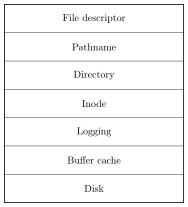
The xv6 file system implementation is organized in seven layers, shown in Figure 10.1. The disk layer reads and writes blocks on a virtio hard drive; virtio is an emulated disk provided by qemu. The buffer cache layer caches disk blocks and synchronizes access to them, making sure that only one kernel process at a time can modify the data stored in any particular block. The logging layer allows higher layers to wrap updates to several blocks in a transaction, and ensures that the blocks are updated atomically in the face of crashes (i.e., all of them are updated or none). The inode layer provides individual files, each represented as an inode with a unique i-number and some blocks holding the file’s data. The directory layer implements each directory as a special kind of inode whose content is a sequence of directory entries, each of which contains a file’s name and i-number. The pathname layer provides hierarchical path names like /usr/rtm/xv6/fs.c, and resolves them with recursive lookup. The file descriptor layer abstracts many Unix resources (e.g., pipes, devices, files, etc.) using the file system interface, simplifying the lives of application programmers.
Disk hardware traditionally presents the data on the disk as a numbered sequence of 512-byte sectors: sector 0 is the first 512 bytes, sector 1 is the next, and so on. The disk hardware supports reads and writes only in whole multiples of sectors. Thus, for example, if the operating system needs to change a single byte on the disk, it must read the whole surrounding sector into memory, update the one byte, and then write the whole sector back to the disk. For this reason, file systems allocate disk space for files in units of one or more sectors. The allocation granularity that a file system uses is called the block size. Most file systems use multi-sector blocks for better efficiency; xv6 uses a block size of two sectors (determined by BSIZE in fs.h).
Xv6 holds copies of blocks that it has read into memory in objects of type struct buf. The data stored in this structure is sometimes not the same as the data on the disk: it might have not yet been read in from disk (the disk is working on it but hasn’t returned the block’s content yet), or it might have been updated by software but not yet written to the disk.

The file system must have a plan for where it stores inodes and content blocks on the disk. To do so, xv6 divides the disk into several sections, as Figure 10.2 shows. The file system does not use block 0 (block 0 often holds boot code, though in xv6 it’s merely unused). Block 1 is called the superblock; it contains metadata about the file system (the file system size in blocks, the number of data blocks, the number of inodes, and the number of blocks in the log). Blocks starting at 2 hold the log. After the log are the inodes, with multiple inodes per block. After those come bitmap blocks tracking which data blocks are in use. The remaining blocks are data blocks; each is either marked free in the bitmap block, or holds content for a file or directory.
An xv6 file system is initially created by a program outside of xv6 called mkfs. mkfs writes the superblock, initializes an inode for the (empty) root directory, and marks all i-nodes and data blocks as free.
At this point please read the files kernel/buf.h, kernel/fs.h, kernel/fs.c, kernel/sysfile.c, and kernel/file.c.
10.2 Buffer cache layer
The buffer cache has two jobs: (1) synchronize access to disk blocks to ensure that only one copy of a block is in memory and that only one kernel thread at a time uses that copy; (2) cache popular blocks so that they don’t need to be re-read from the slow disk. The code is in bio.c.
The main interface exported by the buffer cache consists of bread and bwrite; the former obtains a buf containing a copy of a block which can be read or modified in memory, and the latter writes a modified buffer to the appropriate block on the disk. A kernel thread must release a buffer by calling brelse when it is done with it. The buffer cache uses a per-buffer sleep-lock to ensure that only one thread at a time uses each buffer (and thus each disk block); bread returns a locked buffer, and brelse releases the lock.
The buffer cache has a fixed number of buffers to hold disk blocks, which means that if the file system asks for a block that is not already in the cache, the buffer cache must recycle a buffer currently holding some other block. The buffer cache recycles the least recently used buffer for the new block. The assumption is that the least recently used buffer is the one least likely to be used again soon.
There are two interactions between the buffer cache layer and the logging layer: 1) to implement transactions, file-system layers above the logging layer update a disk block by calling log_write, which is a proxy for bwrite and only the logging layer calls bwrite; 2) the buffer cache cannot recycle a buffer that is in use by a transaction until the logging layer commits the transaction (see Section 11.2). To avoid recycling too early, the logging layer uses the buffer-cache functions bpin and bunpin to pin and unpin a buffer in the buffer cache.
At this point please read the files kernel/bio.c and kernel/log.c.
10.3 Code: Buffer cache
The buffer cache is a doubly-linked list of buffers. The function binit, called by main, initializes the list with the NBUF buffers in the static array buf. All other access to the buffer cache refer to the linked list via bcache.head, not the buf array.
A buffer has two state fields associated with it. The field valid indicates that the buffer contains a copy of the block. The field disk indicates that the buffer content has been handed to the disk, which may change the buffer (e.g., write data from the disk into data).
bread calls bget to get a buffer for the given block (bio.c:96). If the buffer needs to be read from disk, bread calls virtio_disk_rw to do that before returning the buffer.
bget scans the buffer list for a buffer with the given device and block numbers (bio.c:64-72). If there is such a buffer, bget acquires the sleep-lock for the buffer. bget then returns the locked buffer.
If there is no cached buffer for the given block, bget must make one, possibly reusing a buffer that held a different block. It scans the buffer list a second time, looking for a buffer that is not in use (b->refcnt = 0); any such buffer can be used. bget edits the buffer metadata to record the new device and block number and acquires its sleep-lock. Note that the assignment b->valid = 0 ensures that bread will read the block data from disk rather than incorrectly using the buffer’s previous contents.
It is important that there is at most one cached buffer per disk block, to ensure that readers see writes, and because the file system uses locks on buffers for synchronization. bget ensures this invariant by holding the bcache.lock continuously from the first loop’s check of whether the block is cached through the second loop’s declaration that the block is now cached (by setting dev, blockno, and refcnt). This causes the check for a block’s presence and (if not present) the designation of a buffer to hold the block to be atomic.
It is safe for bget to acquire the buffer’s sleep-lock outside of the bcache.lock critical section, since the non-zero b->refcnt prevents the buffer from being re-used for a different disk block. The sleep-lock protects reads and writes of the block’s buffered content, while the bcache.lock protects information about which blocks are cached.
If all the buffers are busy, then too many processes are simultaneously executing file system calls; bget panics. A more graceful response might be to sleep until a buffer became free, though there would then be a possibility of deadlock.
Once bread has read the disk (if needed) and returned the buffer to its caller, the caller has exclusive use of the buffer and can read or write the data bytes. If the caller does modify the buffer, it must call bwrite to write the changed data to disk before releasing the buffer. bwrite calls virtio_disk_rw to talk to the disk hardware.
When the caller is done with a buffer, it must call brelse to release it. (The name brelse, a shortening of b-release, is cryptic but worth learning: it originated in Unix and is used in BSD, Linux, and Solaris too.) brelse releases the sleep-lock and moves the buffer to the front of the linked list (bio.c:128-133). Moving the buffer causes the list to be ordered by how recently the buffers were used (meaning released): the first buffer in the list is the most recently used, and the last is the least recently used. The two loops in bget take advantage of this: the scan for an existing buffer must process the entire list in the worst case, but checking the most recently used buffers first (starting at bcache.head and following next pointers) will reduce scan time when there is good locality of reference. The scan to pick a buffer to reuse picks the least recently used buffer by scanning backward (following prev pointers).
10.4 Code: Block allocator
File and directory content is stored in disk blocks, which must be allocated from a free pool. Xv6’s block allocator maintains a free bitmap on disk, with one bit per block. A zero bit indicates that the corresponding block is free; a one bit indicates that it is in use. When it creates a new file system, mkfs sets the bits corresponding to the boot sector, superblock, log blocks, inode blocks, and bitmap blocks.
The block allocator provides two functions: balloc allocates a new disk block, and bfree frees a block. The loop in balloc at (fs.c:74) considers every block, starting at block 0 up to sb.size, the number of blocks in the file system. It looks for a block whose bitmap bit is zero, indicating that it is free. If balloc finds such a block, it updates the bitmap and returns the block. For efficiency, the loop is split into two pieces. The outer loop reads each block of bitmap bits. The inner loop checks all Bits-Per-Block (BPB) bits in a single bitmap block. The race that might occur if two processes try to allocate a block at the same time is prevented by the fact that the buffer cache only lets one process use any one bitmap block at a time (see Section 10.2).
bfree finds the right bitmap block and clears the right bit. Again the exclusive use implied by bread and brelse avoids the need for explicit locking.
As with much of the code described in the remainder of this chapter, balloc and bfree must be called inside a transaction.
10.5 Inode layer
The term inode can have one of two related meanings. It might refer to the on-disk data structure containing a file’s size and list of data block numbers. Or “inode” might refer to an in-memory inode, which contains a copy of the on-disk inode as well as extra information needed within the kernel.
The on-disk inodes are packed into a contiguous area of disk called the inode blocks. Every inode is the same size, so it is easy, given a number n, to find the nth inode on the disk. In fact, this number n, called the inode number or i-number, is how inodes are identified in the implementation.
The on-disk inode is defined by a struct dinode. The type field distinguishes between files, directories, and special files (devices). A type of zero indicates that an on-disk inode is free. The nlink field counts the number of directory entries that refer to this inode, in order to recognize when the on-disk inode and its data blocks should be freed. The size field records the number of bytes of content in the file. The addrs array records the block numbers of the disk blocks holding the file’s content.
The kernel keeps the set of active inodes in memory in a table called itable; struct inode is the in-memory copy of a struct dinode on disk. The kernel stores an inode in memory only if there are C pointers referring to that inode. The ref field counts the number of C pointers referring to the in-memory inode, and the kernel discards the inode from memory if the reference count drops to zero. The iget and iput functions acquire and release pointers to an inode, modifying the reference count. Pointers to an inode can come from file descriptors, current working directories, and transient kernel code such as kexec.
There are four lock or lock-like mechanisms in xv6’s inode code. itable.lock protects the invariant that an inode is present in the inode table at most once, and the invariant that an in-memory inode’s ref field counts the number of in-memory pointers to the inode. Each in-memory inode has a lock field containing a sleep-lock, which ensures exclusive access to the inode’s fields (such as file length) as well as to the inode’s file or directory content blocks. An inode’s ref, if it is greater than zero, causes the system to maintain the inode in the table, and not re-use the table entry for a different inode. Finally, each inode contains a nlink field (on disk and copied in memory if in memory) that counts the number of directory entries that refer to a file; xv6 won’t free an inode if its link count is greater than zero.
A struct inode pointer returned by iget() is guaranteed to be valid until the corresponding call to iput(); the inode won’t be deleted, and the memory referred to by the pointer won’t be re-used for a different inode. iget() provides non-exclusive access to an inode, so that there can be many pointers to the same inode. Many parts of the file-system code depend on this behavior of iget(), both to hold long-term references to inodes (as open files and current directories) and to prevent races while avoiding deadlock in code that manipulates multiple inodes (such as pathname lookup).
The struct inode that iget returns may not have any useful content. In order to ensure it holds a copy of the on-disk inode, code must call ilock. This locks the inode (so that no other process can ilock it) and reads the inode from the disk, if it has not already been read. iunlock releases the lock on the inode. Separating acquisition of inode pointers from locking helps avoid deadlock in some situations, for example during directory lookup. Multiple processes can hold a C pointer to an inode returned by iget, but only one process can lock the inode at a time.
The inode table only stores inodes to which kernel code or data structures hold C pointers. Its main job is synchronizing access by multiple processes. The inode table also happens to cache frequently-used inodes, but caching is secondary; if an inode is used frequently, the buffer cache will probably keep it in memory. Code that modifies an in-memory inode writes it to disk with iupdate.
10.6 Code: Inodes
To allocate a new inode (for example, when creating a file), xv6 calls ialloc. ialloc is similar to balloc: it loops over the inode structures on the disk, one block at a time, looking for one that is marked free. When it finds one, it claims it by writing the new type to the disk and then returns an entry from the inode table with the tail call to iget. The correct operation of ialloc depends on the fact that only one process at a time can be holding a reference to bp: ialloc can be sure that some other process does not simultaneously see that the inode is available and try to claim it.
iget looks through the inode table for an active entry (ip->ref > 0) with the desired device and inode number. If it finds one, it returns a new reference to that inode (fs.c:258-262). As iget scans, it records the position of the first empty slot (fs.c:263-264), which it uses if it needs to allocate a table entry.
Code must lock the inode using ilock before reading or writing its metadata or content. ilock uses a sleep-lock for this purpose. Once ilock has exclusive access to the inode, it reads the inode from disk (more likely, the buffer cache) if needed. The function iunlock releases the sleep-lock, which may cause any processes sleeping to be woken up.
iput releases a C pointer to an inode by decrementing the reference count (fs.c:373). If this is the last reference, the inode’s slot in the inode table is now free and can be re-used for a different inode.
If iput sees that there are no C pointer references to an inode and that the inode has no links to it (occurs in no directory) (fs.c:357), then the inode and its data blocks must be freed. iput calls itrunc to truncate the file to zero bytes, freeing the data blocks, and then calls ifree to set the inode’s type to 0 (unallocated) on disk.
The locking protocol in iput in the case in which it frees the inode deserves a closer look. One danger is that a concurrent thread might be waiting in ilock to use this inode (e.g., to read a file or list a directory), and won’t be prepared to find that the inode is no longer allocated. This can’t happen because there is no way for a system call to get a pointer to an in-memory inode if it has no links to it and ip->ref is one. That one reference is the reference owned by the thread calling iput. The other main danger is that a concurrent call to ialloc might choose the same inode that iput is freeing. This can happen only after ifree writes the disk so that the inode has type zero. iput calls ifree last, after it has truncated the inode, released the inode’s sleep-lock, and dropped its own reference. So by the time the allocating thread can see that the inode is free, iput is done with it, and the race is benign.
iput() can write to the disk. This means that any system call that uses the file system may write to the disk, because the system call may be the last one having a reference to the file. Even calls like read() that appear to be read-only, may end up calling iput(). This, in turn, means that even read-only system calls must be wrapped in transactions if they use the file system.
There is a challenging interaction between iput() and crashes. iput() doesn’t truncate a file immediately when the link count for the file drops to zero, because some process might still hold a reference to the inode in memory: a process might still be reading and writing to the file, because it successfully opened it. But, if a crash happens before the last process closes the file descriptor for the file, then the file will be marked allocated on disk but no directory entry will point to it.
File systems handle this case in one of two ways. The simple solution is that on recovery, after reboot, the file system scans the whole file system for files that are marked allocated, but have no directory entry pointing to them. If any such file exists, then it can free those files. This is the solution implemented by xv6. During boot, fsinit calls ireclaim, which examines every on-disk inode, looking for ones that are marked allocated (non-zero type) but have a link count of zero; these are exactly the files that had been unlinked but were still open when the crash occurred. For each such orphan, ireclaim calls iput to free the inode and its data blocks.
The second solution doesn’t require scanning the file system. In this solution, the file system records on disk (e.g., in the super block) the inode inumber of a file whose link count drops to zero but whose reference count isn’t zero. If the file system removes the file when its reference count reaches 0, then it updates the on-disk list by removing that inode from the list. On recovery, the file system frees any file in the list.
10.7 Code: Inode content

The on-disk inode structure, struct dinode, contains a size and an array of block numbers (see Figure 10.3). The inode data is found in the blocks listed in the dinode ’s addrs array. The first NDIRECT blocks of data are listed in the first NDIRECT entries in the array; these blocks are called direct blocks. The next NINDIRECT blocks of data are listed not in the inode but in a data block called the indirect block. The last entry in the addrs array gives the address of the indirect block. Thus the first 12 kB ( NDIRECT x BSIZE) bytes of a file can be loaded from blocks listed in the inode, while the next 256 kB ( NINDIRECT x BSIZE) bytes can only be loaded after consulting the indirect block. This is a good on-disk representation but a complex one for clients. The function bmap manages the representation so that higher-level routines, such as readi and writei, which we will see shortly, do not need to manage this complexity. bmap returns the disk block number of the bn’th data block for the inode ip. If ip does not have such a block yet, bmap allocates one.
The function bmap begins by picking off the easy case: the first NDIRECT blocks are listed in the inode itself (fs.c:426-434). The next NINDIRECT blocks are listed in the indirect block at ip->addrs[NDIRECT]. bmap reads the indirect block (fs.c:445) and then reads a block number from the right position within the block (fs.c:446). If the block number exceeds NDIRECT+NINDIRECT, bmap panics; writei contains the check that prevents this from happening (fs.c:551).
bmap allocates blocks as needed. An ip->addrs[] or indirect entry of zero indicates that no block is allocated. As bmap encounters zeros, it replaces them with the numbers of fresh blocks, allocated on demand (fs.c:427-428) (fs.c:439-440).
itrunc frees a file’s blocks, resetting the inode’s size to zero. itrunc starts by freeing the direct blocks (fs.c:470-475), then the ones listed in the indirect block (fs.c:480-483), and finally the indirect block itself (fs.c:485-486).
bmap makes it easy for readi and writei to get at an inode’s data. readi starts by making sure that the offset and count are not beyond the end of the file. Reads that start beyond the end of the file return an error (fs.c:515-516) while reads that start at or cross the end of the file return fewer bytes than requested (fs.c:517-518). The main loop processes each block of the file, copying data from the buffer into dst. writei is identical to readi, with three exceptions: writes that start at or cross the end of the file grow the file, up to the maximum file size (fs.c:551-552); the loop copies data into the buffers instead of out (fs.c:560); and if the write has extended the file, writei must update its size (fs.c:570-571).
The function stati copies inode metadata into the stat structure, which is exposed to user programs via the stat system call.
10.8 Code: Directory layer
A directory is implemented internally much like a file. Its inode has type T_DIR and its data is a sequence of directory entries. Each entry is a struct dirent, which contains a name and an inode number. The name is at most DIRSIZ (14) characters; if shorter, it is terminated by a NULL (0) byte. Directory entries with inode number zero are free.
The reason why a directory entry contains the file’s i-number rather than the named file’s entire i-node is to support “links” created by the link() system call. An i-node can be referred to in multiple directories, and thus under multiple path names; each of an i-node’s names (i.e. directory entries) is called a link. Because of the possibility of an i-node being named in multiple directories, it is not convenient for the i-node to be stored in any one of those directories. The possibility of multiple links is also the reason for the nlink field in the i-node. The fact that i-nodes are stored separately from directories also allows sensible handling of a file being unlinked (removed) while some process has a file descriptor referring to the file: the file descriptor refers to the i-node, not to any directory entry, so the file descriptor will still work even though the file (really, just its name) has been removed.
The function dirlookup searches a directory for an entry with the given name. If it finds one, it returns a pointer to the corresponding inode, unlocked, and sets *poff to the byte offset of the entry within the directory, in case the caller wishes to edit it. If dirlookup finds an entry with the right name, it updates *poff and returns an unlocked inode obtained via iget. dirlookup is the reason that iget returns unlocked inodes. The caller has locked dp, so if the lookup was for ., an alias for the current directory, attempting to lock the inode before returning would try to re-lock dp and deadlock. (There are more complicated deadlock scenarios involving multiple processes and .., an alias for the parent directory; . is not the only problem.) The caller can unlock dp and then lock ip, ensuring that it only holds one lock at a time.
The function dirlink writes a new directory entry with the given name and inode number into the directory dp. If the name already exists, dirlink returns an error (fs.c:626-630). The main loop reads directory entries looking for an unallocated entry. When it finds one, it stops the loop early (fs.c:632-637), with off set to the offset of the available entry. Otherwise, the loop ends with off set to dp->size. Either way, dirlink then adds a new entry to the directory by writing at offset off.
10.9 Code: Path names
Path name lookup involves a succession of calls to dirlookup, one for each path component. namei evaluates path and returns the corresponding inode. The function nameiparent is a variant: it stops before the last element, returning the inode of the parent directory and copying the final element into name. Both call the generalized function namex to do the real work.
namex starts by deciding where the path evaluation begins. If the path begins with a slash, evaluation begins at the root; otherwise, the current directory (fs.c:696-699). Then it uses skipelem to consider each element of the path in turn (fs.c:701). Each iteration of the loop must look up name in the current inode ip. The iteration begins by locking ip and checking that it is a directory. If not, the lookup fails (fs.c:702-706). (Locking ip is necessary not because ip->type can change underfoot—it can’t—but because until ilock runs, ip->type is not guaranteed to have been loaded from disk.) If the call is nameiparent and this is the last path element, the loop stops early, as per the definition of nameiparent; the final path element has already been copied into name, so namex need only return the unlocked ip. Finally, the loop looks for the path element using dirlookup and prepares for the next iteration by setting ip = next. When the loop runs out of path elements, it returns ip.
The procedure namex may take a long time to complete: it could involve several disk operations to read inodes and directory blocks for the directories traversed in the pathname (if they are not in the buffer cache). Xv6 is carefully designed so that if an invocation of namex by one kernel thread is blocked on a disk I/O, another kernel thread looking up a different pathname can proceed concurrently. namex locks each directory in the path separately so that lookups in different directories can proceed in parallel.
This concurrency introduces some challenges. For example, while one kernel thread is looking up a pathname another kernel thread may be changing the directory tree by unlinking a directory. A potential risk is that a lookup may be searching a directory that has been deleted by another kernel thread and its blocks have been re-used for another directory or file.
Xv6 avoids such races. For example, when executing dirlookup in namex, the lookup thread holds the lock on the directory and dirlookup returns an inode that was obtained using iget. iget increases the reference count of the inode. Only after receiving the inode from dirlookup does namex release the lock on the directory. Now another thread may unlink the inode from the directory but xv6 will not delete the inode yet, because the reference count of the inode is still larger than zero.
Another risk is deadlock. For example, next points to the same inode as ip when looking up ".". Locking next before releasing the lock on ip would result in a deadlock. To avoid this deadlock, namex unlocks the directory before obtaining a lock on next. Here again we see why the separation between iget and ilock is important.
10.10 File descriptor layer
A cool aspect of the Unix interface is that most resources in Unix are represented as files, including devices such as the console, pipes, and of course, real files. The file descriptor layer is the layer that achieves this uniformity.
Xv6 gives each process its own table of open files, or file descriptors, as we saw in Chapter 1. Each open file is represented by a struct file, which is a wrapper around either an inode or a pipe, plus an I/O offset. Each call to open creates a new open file (a new struct file): if multiple processes open the same file independently, the different instances will have different I/O offsets. On the other hand, a single open file (the same struct file) can appear multiple times in one process’s file table and also in the file tables of multiple processes. This would happen if one process used open to open the file and then created aliases using dup or shared it with a child using fork. A reference count tracks the number of references to a particular open file. A file can be open for reading or writing or both. The readable and writable fields track this.
All the open files in the system are kept in a global file table, the ftable. The file table has functions to allocate a file (filealloc), create a duplicate reference (filedup), release a reference (fileclose), and read and write data (fileread and filewrite).
The first three follow the now-familiar form. filealloc scans the file table for an unreferenced file (f->ref == 0) and returns a new reference; filedup increments the reference count; and fileclose decrements it. When a file’s reference count reaches zero, fileclose releases the underlying pipe or inode, according to the type.
The functions filestat, fileread, and filewrite implement the fstat, read, and write operations on files. filestat is only allowed on inodes and calls stati. fileread and filewrite check that the operation is allowed by the open mode and then pass the call through to either the pipe or inode implementation. If the file represents an inode, fileread and filewrite use the I/O offset as the offset for the operation and then advance it (file.c:122-123) (file.c:162-163). Pipes have no concept of offset. Recall that the inode functions require the caller to handle locking (file.c:94-96) (file.c:121-124) (file.c:161-164). The inode locking has the convenient side effect that the read and write offsets are updated atomically, so that multiple writing to the same file simultaneously cannot overwrite each other’s data, though their writes may end up interlaced.
10.11 Code: System calls
With the functions that the lower layers provide, the implementation of most system calls is trivial (see (sysfile.c)). There are a few calls that deserve a closer look.
The functions sys_link and sys_unlink edit directories, creating or removing references to inodes. They are another good example of the power of using transactions. sys_link begins by fetching its arguments, two strings old and new. Assuming old exists, is not a directory, and has fewer than NLINK_MAX links (sysfile.c:133-145), sys_link increments its ip->nlink count (sysfile.c:151). The limit exists because nlink is a 16-bit field in the on-disk inode; without the check, creating too many links would overflow the count. Then sys_link calls nameiparent to find the parent directory and final path element of new and creates a new directory entry pointing at old ’s inode (sysfile.c:165). The new parent directory must exist and be on the same device as the existing inode: inode numbers only have a unique meaning on a single disk. If an error like this occurs, sys_link must go back and decrement ip->nlink.
Transactions simplify the implementation because it requires updating multiple disk blocks, but we don’t have to worry about the order in which we do them. They either will all succeed or none. For example, without transactions, updating ip->nlink before creating a link, would put the file system temporarily in an unsafe state, and a crash in between could result in havoc. With transactions we don’t have to worry about this.
sys_link creates a new name for an existing inode. The function create creates a new name for a new inode. It is a generalization of the three file creation system calls: open with the O_CREATE flag makes a new ordinary file, mkdir makes a new directory, and mkdev makes a new device file. Like sys_link, create starts by calling nameiparent to get the inode of the parent directory. It then calls dirlookup to check whether the name already exists (sysfile.c:280). If the name does exist, create’s behavior depends on which system call it is being used for: open has different semantics from mkdir and mkdev. If create is being used on behalf of open (type == T_FILE) and the name that exists is itself a regular file, then open treats that as a success, so create does too (sysfile.c:284). Otherwise, it is an error (sysfile.c:285-286). If the name does not already exist, create now allocates a new inode with ialloc. If the new inode is a directory, create initializes it with . and .. entries. Finally, now that the data is initialized properly, create can link it into the parent directory (sysfile.c:306). create, like sys_link, holds two inode locks simultaneously: ip and dp. There is no possibility of deadlock because the inode ip is freshly allocated: no other process in the system will hold ip ’s lock and then try to lock dp.
Using create, it is easy to implement sys_open, sys_mkdir, and sys_mknod. sys_open is the most complex, because creating a new file is only a small part of what it can do. If open is passed the O_CREATE flag, it calls create. Otherwise, it calls namei. create returns a locked inode, but namei does not, so sys_open must lock the inode itself. This provides a convenient place to check that directories are only opened for reading, not writing. Assuming the inode was obtained one way or the other, sys_open allocates a file and a file descriptor (sysfile.c:368) and then fills in the file (sysfile.c:380-385). Note that no other process can access the partially initialized file since it is only in the current process’s table.
Chapter 9 examined the implementation of pipes before we even had a file system. The function sys_pipe connects that implementation to the file system by providing a way to create a pipe pair. Its argument is a pointer to space for two integers, where it will record the two new file descriptors. Then it allocates the pipe and installs the file descriptors.
10.12 Real world
The buffer cache in a real-world operating system is significantly more complex than xv6’s, but it serves the same two purposes: caching and synchronizing access to the disk. Xv6’s buffer cache uses a least recently used (LRU) eviction policy; there are many more complex policies that can be implemented, each good for some workloads and not as good for others. A more efficient LRU cache would eliminate the linked list, instead using a hash table for lookups and a heap for LRU evictions. Modern buffer caches are typically integrated with the virtual memory system to support memory-mapped files.
Xv6 uses an on-disk layout of inodes and directories similar to that of early UNIX; this scheme has been remarkably persistent over the years. BSD’s UFS/FFS and Linux’s ext2/ext3 use essentially the same data structures. The most inefficient part of the file system layout is the directory, which requires a linear scan over all the disk blocks during each lookup. This is reasonable when directories are only a few disk blocks, but is expensive for directories holding many files. Microsoft Windows’s NTFS, macOS’s HFS, and Solaris’s ZFS, just to name a few, implement a directory as an on-disk balanced tree of blocks. This is complicated but guarantees logarithmic-time directory lookups.
Xv6 requires that the file system fit on one disk device and not change in size. As large databases and multimedia files drive storage requirements ever higher, operating systems are developing ways to eliminate the “one disk per file system” bottleneck. The basic approach is to combine many disks into a single logical disk. Hardware solutions such as RAID are still the most popular, but the current trend is moving toward implementing as much of this logic in software as possible. These software implementations typically allow rich functionality like growing or shrinking the logical device by adding or removing disks on the fly. Of course, a storage layer that can grow or shrink on the fly requires a file system that can do the same: the fixed-size array of inode blocks used by xv6 would not work well in such environments. Separating disk management from the file system may be the cleanest design, but the complex interface between the two has led some systems, like Sun’s ZFS, to combine them.
Xv6’s file system lacks many other features of modern file systems; for example, it lacks support for snapshots and incremental backup.
Modern Unix systems allow many kinds of resources to be accessed with the same system calls as on-disk storage: named pipes, network connections, remotely-accessed network file systems, and monitoring and control interfaces such as /proc. Instead of xv6’s if statements in fileread and filewrite, these systems typically give each open file a table of function pointers, one per operation, and call the function pointer to invoke that inode’s implementation of the call. Network file systems and user-level file systems provide functions that turn those calls into network RPCs and wait for the response before returning.
10.13 Exercises
Why panic in
balloc? Can xv6 recover?Why panic in
ialloc? Can xv6 recover?Why doesn’t
fileallocpanic when it runs out of files? Why is this more common and therefore worth handling?Suppose the file corresponding to
ipgets unlinked by another process betweensys_link’s calls toiunlock(ip)anddirlink. Will the link be created correctly? Why or why not?createmakes four function calls (one toiallocand three todirlink) that it requires to succeed. If any doesn’t,createcallspanic. Why is this acceptable? Why can’t any of those four calls fail?sys_chdircallsiunlock(ip)beforeiput(cp->cwd), which might try to lockcp->cwd, yet postponingiunlock(ip)until after theiputwould not cause deadlocks. Why not?Implement the
lseeksystem call. Supportinglseekwill also require that you modifyfilewriteto fill holes in the file with zero iflseeksetsoffbeyondf->ip->size.Add
O_TRUNCandO_APPENDtoopen, so that>and>>operators work in the shell.Modify the file system to support symbolic links.
Modify the file system to support named pipes.
Modify the file and VM system to support memory-mapped files.