4 Traps and system calls
There are three kinds of event which cause the CPU to set aside ordinary execution of instructions and force a transfer of control to special kernel code that handles the event. One situation is a system call, when a user program executes the ecall instruction to ask the kernel to do something for it. Another situation is an exception: an instruction (user or kernel) does something illegal, such as load from an invalid virtual address. The third situation is a device interrupt, when a device signals that it needs attention, for example when the disk hardware finishes a read or write request.
This book uses trap as a generic term for these situations. Typically whatever code was executing at the time of the trap will later need to resume, and shouldn’t need to be aware that anything special happened. That is, we often want traps to be transparent; this is particularly important for device interrupts, which the interrupted code typically doesn’t expect. A trap forces a transfer of control into the kernel; the kernel saves registers and other state so that execution can be resumed; the kernel executes appropriate handler code (e.g., a system call implementation or device driver); the kernel restores the saved state and returns from the trap; and the original code resumes where it left off.
Xv6 handles all traps in the kernel; traps are not delivered to user code. Handling traps in the kernel is natural for system calls. It makes sense for interrupts since isolation demands that only the kernel be allowed to use devices, and because the kernel is able to share devices among multiple processes. It also makes sense for exceptions since the kernel may be able to handle the exception from user space (for an example see Chapter 5) or respond by killing the offending program.
Xv6 trap handling proceeds in four stages: hardware actions taken by the RISC-V CPU, some assembly instructions that prepare the way for kernel C code, a C function that decides what to do with the trap, and the system call or device-driver service routine. While commonality among the three trap types suggests that a kernel could handle all traps with a single code path, it turns out to be convenient to have separate code for two distinct cases: traps from user space, and traps from kernel space. Kernel code (assembler or C) that processes a trap is often called a handler; the first handler instructions are usually written in assembler (rather than C) and are sometimes called a vector.
Before proceeding, please read kernel/trampoline.S, and usertrap() and prepare_return() in kernel/trap.c.
4.1 RISC-V trap machinery
Each RISC-V CPU has a set of hardware control registers that the kernel writes to tell the CPU how to handle traps, and that the kernel can read to find out about a trap that has occurred. The RISC-V documents contain the full story (Waterman et al. 2024). riscv.h contains definitions that xv6 uses. Here’s an outline of the most important registers:
stvec: The kernel writes the address of its trap handler code here; the RISC-V jumps to the address instvecto handle a trap.sepc: When a trap occurs, RISC-V saves the program counter here (since thepcis then overwritten with the value instvec). Thesret(return from trap) instruction copiessepcto thepc. The kernel can writesepcto control wheresretgoes.scause: RISC-V puts a number here that describes the reason for the trap.sscratch: The kernel trap handler code usessscratchto help it avoid overwriting user registers before saving them.sstatus: The SIE bit insstatuscontrols whether device interrupts are enabled. If the kernel clears SIE, the RISC-V will defer device interrupts until the kernel sets SIE. The SPP bit indicates whether a trap came from user mode or supervisor mode, and controls to what modesretreturns.
The above registers can only be accessed in supervisor mode (i.e., by the kernel); the CPU prevents user code from reading or writing them.
Each CPU on a multi-core chip has its own set of these registers, and more than one CPU may be handling a trap at any given time.
When it forces a trap, the RISC-V hardware does the following:
If the trap is a device interrupt, and the
sstatusSIE bit is clear, don’t do any of the following.Disable interrupts by clearing the SIE bit in
sstatus.Copy the
pctosepc.Save the current mode (user or supervisor) in the SPP bit in
sstatus.Set
scauseto a number indicating the trap’s cause.Set the mode to supervisor.
Copy
stvecto thepc.Start executing at the new
pc.
The CPU doesn’t switch to the kernel page table, doesn’t switch to a stack in the kernel, and doesn’t save any registers other than the pc. Kernel software must perform these tasks. One reason that the CPU does minimal work during a trap is to provide flexibility to software; for example, some operating systems omit a page table switch in some situations to increase trap performance.
It’s worth thinking about whether any of the steps listed above could be omitted, perhaps in search of faster traps. Though there are situations in which a simpler sequence can work, many of the steps would be dangerous to omit in general. For example, suppose that the CPU didn’t switch program counters. Then a trap from user space could switch to supervisor mode while still running user instructions. Those user instructions could break user/kernel isolation, for example by modifying the satp register to point to a page table that allowed accessing all of physical memory. It is thus important that the CPU switch to a kernel-specified instruction address, namely stvec.
4.2 Traps from user space
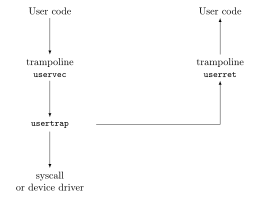
Xv6 handles traps differently depending on whether the trap occurs while executing in the kernel or in user code. Here is the story for traps from user code; Section 4.5 describes traps from kernel code.
A trap may occur while executing in user space if the user program makes a system call (ecall instruction), or does something illegal, or if a device interrupts. As shown in Figure 4.1, the high-level path of a trap from user space is uservec, then usertrap; and when the kernel is ready to return, usertrap returns to userret which executes sret to user space.
A major constraint on the design of xv6’s trap handling is the fact that the RISC-V hardware does not switch page tables when it forces a trap. This means that the trap handler address in stvec must have a valid mapping in the user page table, since that’s the page table in force when the trap handling code starts executing. Furthermore, xv6’s trap handling code needs to switch to the kernel page table; in order to be able to continue executing after that switch, the kernel page table must also have a mapping for the handler pointed to by stvec.
Xv6 satisfies these requirements using a trampoline page. This page contains uservec, the xv6 trap handling code that stvec points to. The trampoline page is mapped in every process’s page table at virtual address 0x3ffffff000 (called TRAMPOLINE), which is the last page in the virtual address space so that it will be above memory that programs use for themselves. The trampoline page is mapped at the same virtual address in the kernel page table. See Figure 2.3 and Figure 3.3. Because the trampoline page is mapped in the user page table, traps can start executing there in supervisor mode. Because the trampoline page is mapped at the same address in the kernel address space, the trap handler can continue to execute after it switches to the kernel page table.
The code for the uservec trap handler is in trampoline.S. When uservec starts, all 32 registers contain values owned by the interrupted user code. These 32 values need to be saved somewhere in memory, so that later on the kernel can restore them before returning to user space. Storing to memory requires use of a register to hold the store’s destination address, but at this point there are no general-purpose registers available! Luckily RISC-V provides a helping hand in the form of the sscratch register. The csrw instruction at the start of uservec saves a0 in sscratch. Now uservec has one register (a0) to play with.
uservec’s next task is to save the 32 user registers. The kernel allocates, for each process, a page of memory for a trapframe structure that (among other things) has space to save the 32 user registers (proc.h:40). Because satp still refers to the user page table, uservec needs the trapframe to be mapped in the user address space. Xv6 maps each process’s trapframe at virtual address TRAPFRAME (0x3fffffe000) in that process’s user page table; one page below TRAMPOLINE. Each process’s p->trapframe contains a kernel virtual address for the process’s trapframe.
uservec sets register a0 to address TRAPFRAME and saves all the user registers there. Then it retrieves the user a0 from sscratch and saves it in the trapframe.
The kernel previously initialized the trapframe to contain some values useful to uservec: the address of the current process’s kernel stack, the current CPU’s hartid, the address of the usertrap function, and the address of the kernel page table. uservec retrieves these values, switches satp to the kernel page table, and jumps to usertrap, a C function.
The job of usertrap is to determine the cause of the trap, process it, and return (trap.c:38). It first changes stvec so that a trap while in the kernel will be handled by kernelvec rather than uservec. It saves the sepc register (the saved user program counter) for future use when returning back to user space. If the trap is a system call, usertrap calls syscall to handle it; if a device interrupt, devintr; if a page fault, vmfault; otherwise it’s an exception (e.g., use of an invalid address), and the kernel kills the faulting process. The system call path adds four to the saved user program counter because RISC-V, in the case of a system call, leaves the program pointer pointing to the ecall instruction but user code needs to resume executing at the subsequent instruction. usertrap checks if the process has been killed or should yield the CPU (if this trap is a timer interrupt).
The first step in returning to user space is the call to prepare_return. This function sets up the RISC-V control registers to prepare for a future trap from user space: setting stvec to uservec and preparing the trapframe fields that uservec relies on. prepare_return sets sepc to the previously saved user program counter. Finally, usertrap returns back to userret in the trampoline page (trampoline.S:101), passing back a pointer to the user page table in a0.
userret switches satp to the process’s user page table. Recall that the user page table maps both the trampoline page and TRAPFRAME, but nothing else from the kernel. The trampoline page mapping at the same virtual address in user and kernel page tables allows userret to keep executing after changing satp. From this point on, the only data userret can use is the register contents and the content of the trapframe. userret loads the TRAPFRAME address into a0, restores saved user registers from the trapframe via a0, restores the saved user a0, and executes sret to return to user space.
uservec and userret are written in assembly language because it is difficult to write C code to save or restore all the registers or survive switching page tables.
4.3 Code: Calling system calls
User programs call library functions in order to make system calls. For example, the shell displays a prompt with this function call (in user/sh.c):
write(2, "$ ", 2);Here’s the library function, in user/usys.S:
write:
 li a7, SYS_write
 ecall
 ret
The code that the C compiler generates for the function call loads the three arguments into registers a0, a1, and a2. Then the write() function loads the system call number, SYS_write (16), into a7. The kernel will look at those registers to find out what system call is intended, and what the arguments are. The ecall instruction traps from user space into the kernel and causes uservec, usertrap, and then syscall to execute.
At this point, please read kernel/syscall.c, sys_write() in kernel/sysfile.c, and copyout(), copyin(), and copyinstr() in kernel/vm.c.
syscall retrieves the system call number from the saved a7 in the trapframe and uses it to index into syscalls. For our example, a7 contains SYS_write, resulting in a call to the system call implementation function sys_write.
When sys_write returns, syscall records its return value in p->trapframe->a0. This will cause the original user-space call to write() to return that value, since the C calling convention on RISC-V places return values in a0. System calls conventionally return negative numbers to indicate errors, and zero or positive numbers for success.
4.4 Code: System call arguments
System call arguments start out in the user registers, and are then moved to the trap frame by the kernel trap code. The kernel functions argint, argaddr, and argfd retrieve the n ’th system call argument from the trap frame as an integer, pointer, or a file descriptor.
Some system calls pass pointers as arguments, and the kernel must use those pointers to read or write user memory. The write system call, for example, passes the kernel a user-space pointer to the data to be written. Such pointers pose two challenges. First, the user program may be buggy or malicious, and may pass the kernel an invalid pointer or a pointer intended to trick the kernel into accessing kernel memory instead of user memory. Second, the xv6 kernel page table mappings are not the same as the user page table mappings, so the kernel cannot use ordinary instructions to load or store from user-supplied addresses.
The kernel implements functions that safely transfer data to and from user-supplied addresses. fetchstr is an example (syscall.c:26). File system calls such as exec use fetchstr to retrieve string file-name arguments from user space. fetchstr calls copyinstr to do the hard work.
copyinstr copies up to max bytes to dst from virtual address srcva in the user page table pagetable. Since pagetable is not the current page table, copyinstr uses walkaddr (which calls walk) to look up srcva in pagetable, yielding physical address pa0. The kernel’s page table maps all of physical RAM at virtual addresses that are equal to the RAM’s physical address. This allows copyinstr to directly copy string bytes from pa0 to dst. walkaddr checks that the user-supplied virtual address is part of the process’s user address space, so programs cannot trick the kernel into reading other memory. A similar function, copyout, copies data from the kernel to a user-supplied address.
4.5 Traps from kernel space
Please read kernel/kernelvec.S, and kerneltrap() in kernel/trap.c.
Xv6 handles traps from kernel code in a different way than traps from user code. When entering the kernel, usertrap points stvec to the assembly code at kernelvec. Since kernelvec only executes if xv6 was already in the kernel, kernelvec can rely on satp being set to the kernel page table, and on the stack pointer referring to a valid kernel stack. kernelvec pushes all caller-saved registers onto the current stack, from which it will later restore them so that the interrupted kernel code can resume without disturbance.
kernelvec saves the registers on the stack of the interrupted kernel thread, which makes sense because the register values belong to that thread. This is particularly important if the trap causes a switch to a different thread – in that case the trap will actually return from the stack of the new thread, leaving the interrupted thread’s saved registers safely on its stack.
kernelvec jumps to kerneltrap after saving registers. kerneltrap is prepared for just one type of trap: device interrupts. It calls devintr to handle them. If the trap isn’t a device interrupt, it must be an exception, such as kernel code trying to use an invalid pointer. This could only be caused by a bug in the kernel code. The kernel does not have a way to recover in this situation, so it calls panic(), which prints an error message and then halts.
If kerneltrap was called due to a timer interrupt, and a process’s kernel thread is running (as opposed to a scheduler thread), kerneltrap calls yield to give other threads a chance to run. At some point one of those threads will yield, and let our thread and its kerneltrap resume again. Chapter 8 explains what happens in yield.
When kerneltrap’s work is done, it needs to return to whatever code was interrupted by the trap. Because a yield may have disturbed sepc and the previous mode in sstatus, kerneltrap saves them when it starts. It now restores those control registers and returns to kernelvec. kernelvec pops the saved registers from the stack and executes sret, which copies sepc to pc and resumes the interrupted kernel code.
Xv6 sets a CPU’s stvec to kernelvec when that CPU enters the kernel from user space; you can see this in usertrap. But there’s a window of time when the kernel has started executing but stvec is still set to uservec, and it’s crucial that no device interrupt occur during that window. Luckily the RISC-V always disables interrupts when it starts to take a trap, and usertrap doesn’t enable them again until after it sets stvec.
4.6 Real world
The need for trampoline pages could be eliminated if kernel memory were mapped into every process’s user page table (with PTE_U clear). That would also eliminate the need for a page table switch when trapping from user space into the kernel. That in turn would allow system call implementations in the kernel to take advantage of the current process’s user memory being mapped, allowing kernel code to directly dereference user pointers. Many operating systems have used these ideas to increase efficiency. Xv6 avoids them in order to reduce the chances of security bugs in the kernel due to inadvertent use of user pointers, and to reduce some complexity that would be required to ensure that user and kernel virtual addresses don’t overlap.
4.7 Exercises
Could some or all of the code in
trampoline.Sandkernelvec.Sbe written in C rather than assembler?Is there a way to eliminate the special
TRAPFRAMEpage mapping in every user address space? For example, coulduservecbe modified to simply push the 32 user registers onto the kernel stack, or store them in theprocstructure?Could xv6 be modified to eliminate the special
TRAMPOLINEpage mapping?